Ancestor Question
$149
One research question about one ancestor who has died.
You get
- Written report (PDF)
- GEDCOM file
Plate I · Roots · Atlas Kin
Atlas Kin does the genealogy research for you and delivers your family history as a sourced research wiki. Every claim carries its source. Every dead end is recorded. The finished research makes a gift for the holidays.
Atlas Kin is a research wiki for your family history. Every claim carries its source. Every dead end is recorded. Nothing enters your tree because a stranger clicked accept.
Consumer genealogy optimizes for the opposite behaviour. The dominant interaction on the big platforms is hint-accept: one click merges another user's tree into yours, provenance collapses, and confidence becomes invisible. The result is the well-known failure mode where an unsourced error propagates across thousands of trees and becomes unfalsifiable by repetition.
The thesis is the house style applied to that failure: every number carries its source, every answer admits what it can't know. Genealogy is a domain where false confidence is the defining industry problem rather than an incidental one.
The service
Hourly genealogists commonly bill $50 to $200 an hour. Atlas Kin charges one flat price for a finished result.
$149
One research question about one ancestor who has died.
You get
$449
One direct line, one surname, back four generations.
You get
$749
The Family Line, plus a lineage society application packet (DAR, SAR and similar) prepared for filing.
You get
Society fees are not included.
from $1,190
Every line back four generations.
You get
Final price after we read what you know.
We research ancestors who have died. We do not research living people.
Not affiliated with any lineage society.
The gift
Requests sent by December 22 get the certificate before Christmas.
The certificate does not expire.
See a sample certificate →The feature set
The feature set is derived from a research method that already works on paper rather than invented for a landing page. Each item below is a mechanism that earns its keep in practice.
Every person page carries the same required sections, so a page is never quietly half-finished.
Summary · Timeline · Family Group · Sources · Contradictions · Open Questions
Each claim carries its source, the date it was verified, and a confidence tier. Unsourced claims are visibly flagged — never silently absorbed.
Source / Verified / Confidence
Genealogical Proof Standard tiers appear on the claim itself, not buried in a note no one opens.
high / medium / low / unverified
Searched a given record set, found nothing, on a given date — that is a first-class recorded finding. It stops you re-searching your own dead ends, and it narrows the space that is left.
Session history, a task board, and priority-ranked gaps: what you did, what is next, and what is still unanswered.
Every source tagged, indexed, and linked to the claims it supports, so you can see what a document is actually holding up.
Co-occurrence mining across your sources — the same names recurring as witnesses, neighbours, and sponsors — to surface relatives you did not know to look for.
People found in sources but not yet pinned to a line. A real research state, and one the big platforms have no slot for.
For each line: how deep it goes, what the next step is, and why it ends where it ends.
Extraction and record search produce proposals, not facts. Accept, correct, or reject — the human review step is the product surface, not an afterthought.
Export on demand. No lock-in.
Links, backlinks, a graph view, and orphan detection — the research space behaves like a wiki because that is what it is.
Sources are classified rather than lumped together, so the weight of a record is legible at a glance.
certificate · census · newspaper · church record · ship record · archive finding · secondary
The ancestry map
The research also comes as an interactive ancestry map that opens in a browser.
The family in the demo is invented, and so are its town and its records.
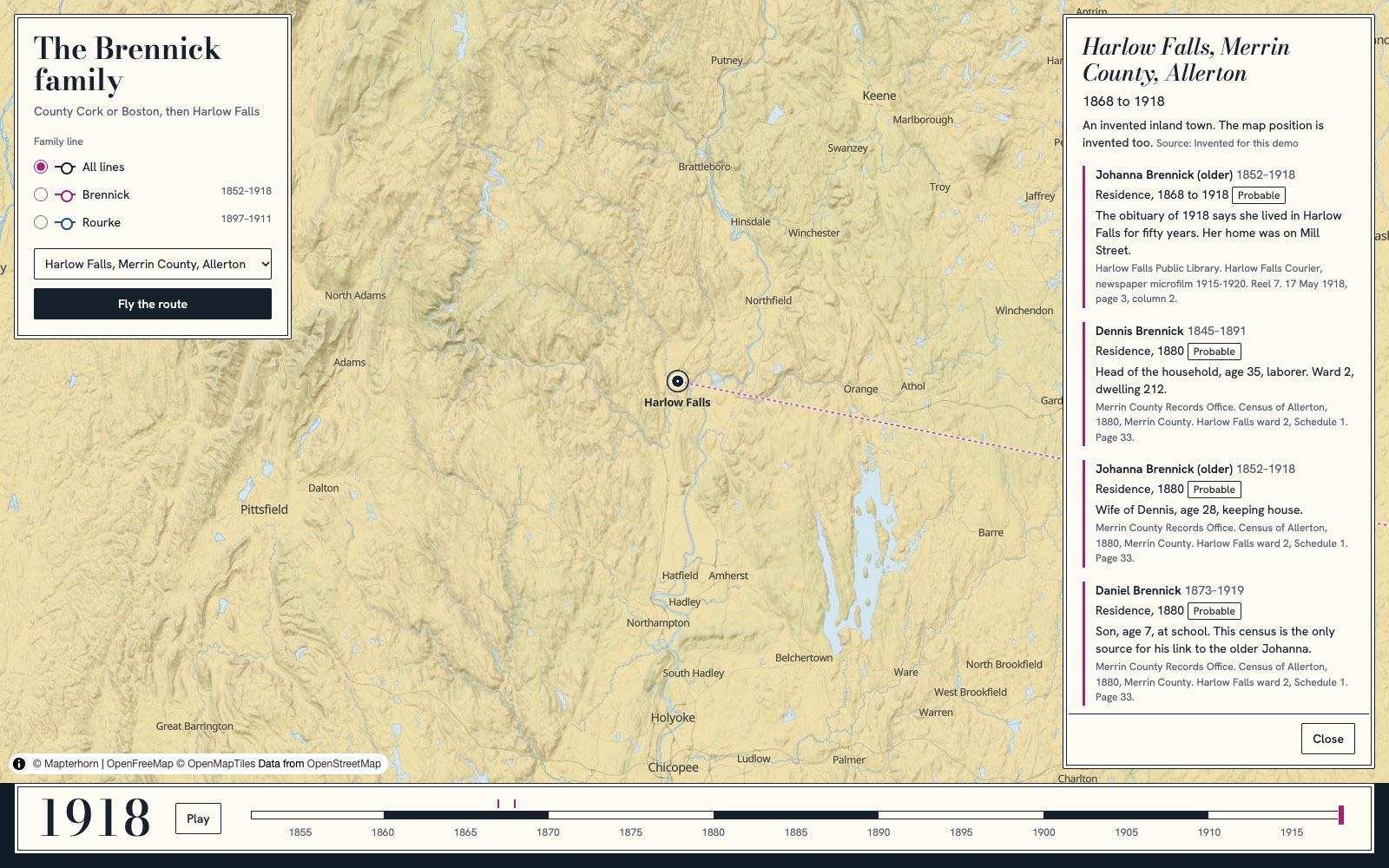
Four screens · illustrative
Four screens from the design. The family in them is invented and so are its records — the mechanism is the point, not the people.
The product below is drawn in full — its screens, its sections and the rules it holds itself to — and this page is where that design is shown.
| Field | Claim | Source | Verified | Confidence |
|---|---|---|---|---|
| Born | 1841 · Whitehaven, Cumberland, England | St Nicholas parish baptisms, Whitehaven, 1841 | 2026-05-02 | high |
| Died | 1899 · Port Hope, Ontario | Headstone, St Mark’s churchyard, Port Hope | 2026-04-20 | medium |
| Father | Josiah Thornbury | St Nicholas parish baptisms, 1841 | 2026-05-02 | high |
| Mother | Hannah Fell | St Nicholas parish baptisms, 1841 | 2026-05-02 | high |
| Spouse | Margaret Ashcroft (1844–1921), m. 1865, Whitehaven | St Nicholas parish marriages, 1865 | 2026-05-02 | high |
| Children | William (1866) · Ada (1868) · Josiah (1871) · Clara (1874) | 1881 Census of Canada, Port Hope, household 214 | 2026-05-02 | medium |
| Occupation | Ship’s carpenter | Family tradition — no document | — | unverified |
Contradiction · unresolved
Birth year. The 1841 baptism register gives 1841. The 1881 census records his age as 39, which implies 1842. Census ages are reported, not documented; the register is the stronger source but the gap is left open.
next: 1851 census of England, Whitehaven, for an Elias aged 9 or 10
Open questions
Found nothing. The family was still in Whitehaven for the 1874 baptism, so they arrived after 1874. Recorded so no one searches 1871 again.
Margaret Ashcroft death resolved: 1921, Port Hope. Elias’s stone confirms 1899 and gives no birth year.
Previously unknown child. One source. Left unpinned until the 1871 baptism register is checked.
Order the Ontario death registration for Elias Thornbury, 1899, Port Hope, to get a stated age and informant.
Board
To do
In progress
Blocked
Done
Selected
Josiah Thornbury jr
b. 1871, Whitehaven · aged 10 in the 1881 census, Port Hope · no later record.
Surfaced from 1881 census, household 214. Appears in one source. Not yet pinned to the line.
Unresolved persons · 2
enumerated April 1881 · 1 page · Thornbury household, 7 persons
A primary record with reported facts: ages and birthplaces are what the household told the enumerator, not what a register says. One source, so every claim below sits at medium until a second record agrees.
Supports · 5 claims
Contradicts · 2
Data inventory · Thornbury line
St Nicholas parish baptisms, Whitehaven, 1841
church_recordhightranscribed 2026-05-02
1881 Census of Canada — Port Hope, household 214
censusmediumingested 2026-05-02
Headstones, St Mark’s churchyard, Port Hope
secondarymediumphotographed 2026-04-20
Ontario death registration — Elias Thornbury, 1899
certificatehighto order
Backlinks · 5 pages cite this source
Scope
Not a tree-hosting or hint-matching service.
There is no social graph, no cross-user tree merge, and no accept-this-stranger’s-ancestor interaction. That interaction is the thing Atlas Kin is positioned against.
Not a records archive.
It does not host or resell primary sources; it cites them.
Not a shared tree.
Your research space is yours, and nothing enters it that you did not put there.
Plate I · Roots
Choose a package and send the request by email.